
Wellness
Cupping Therapy Explained: What It Does and Who It Helps
Cupping works by lifting tissue instead of compressing it. Here's what's actually happening under the cup, what the research does and doesn't show, and how the $20 add-on works.
Published 2/8/2026· By Kristian Fennessy, CMT
Suction instead of pressure
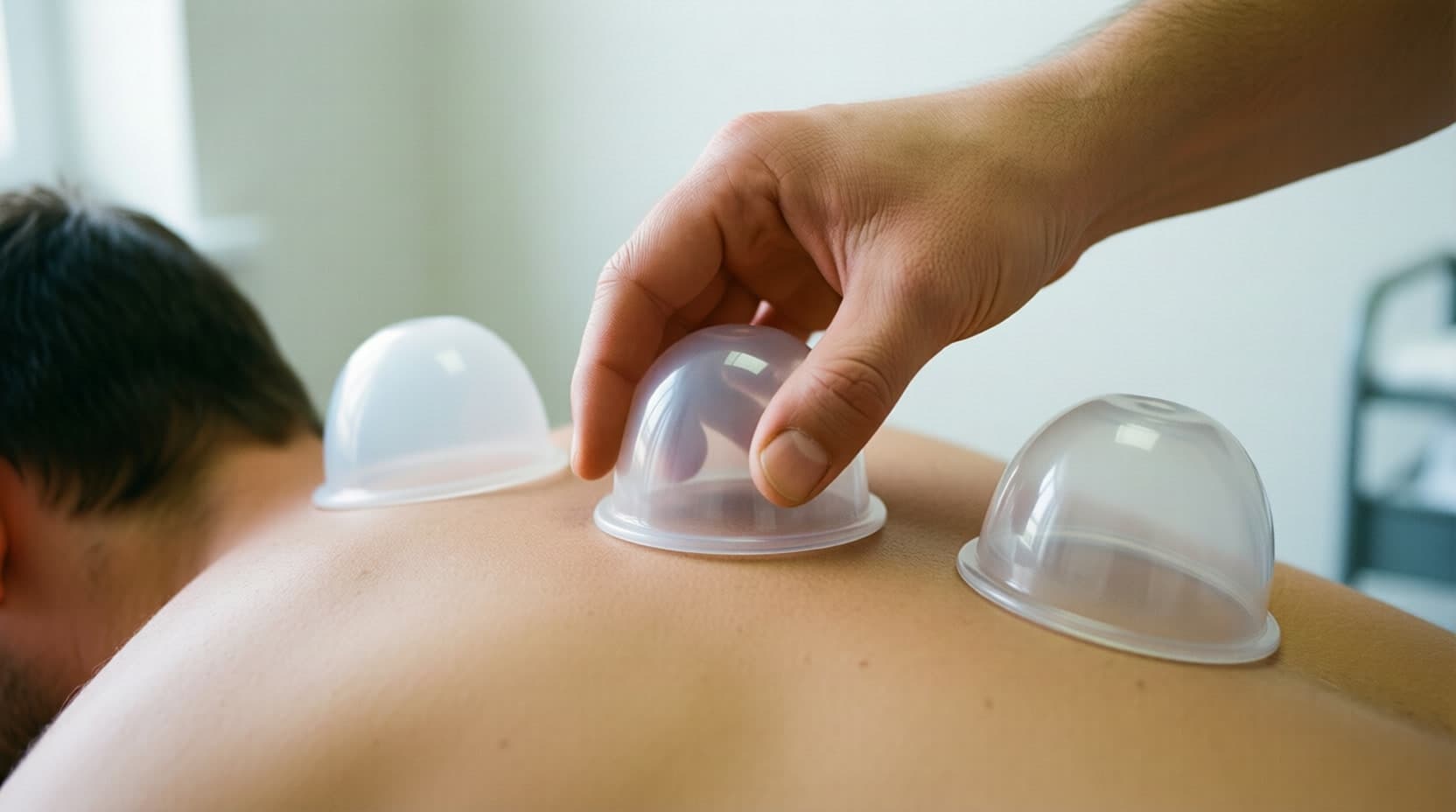
Cupping is the one technique in our kit that works by pulling instead of pressing: cups placed on the skin create suction that lifts the tissue underneath, decompressing an area rather than compressing it. We offer it as a $20 add-on to any session, and for certain kinds of stubborn, long-held tightness, that reversal of direction is exactly what finally gets things to let go.
Nearly everything else that happens on a massage table drives force downward or along the muscle. Hands, forearms, elbows — all compression. Cupping is the counterpoint, and that is the most useful way to understand it: not ancient magic, not an Olympic fad, just force applied in the opposite direction.
What is actually happening under the cup
Three things, as best we currently understand them. The suction lifts the skin and superficial fascia away from the muscle below, which may reduce stickiness between layers that are supposed to glide across each other. It draws blood into the area — that is the color change you see. And it delivers a genuinely unusual sensory signal to the nervous system, which for some people interrupts a guarding pattern that months of ordinary pressure never touched.
What is not happening: toxins are not being pulled out of your body. That explanation survives on spa menus because it sounds satisfying, but there is no meaningful evidence behind it, and cupping does not need it to justify itself. Decompression, fluid movement, and novel input are enough to account for what clients actually feel.
What the evidence says, honestly
The research on cupping is real but thin. Most studies are small, and cupping is nearly impossible to study blind — you know when there is a cup on your back — so the placebo question never fully goes away. Reviews of the musculoskeletal research tend to land in the same place: results lean positive for pain and tightness, quality is low, better trials are needed.
So here is the frame we use with clients. Cupping may help with muscular pain and restricted tissue. The proposed mechanisms are plausible. The risk, done properly on healthy skin, is low. And it does not treat or cure anything — if someone sells you cupping as a therapy for disease, walk away. That is a modest pitch, and we are comfortable with it, because the modest version is the true one.
About the marks
The circles are the famous part, so let's be precise about them. They are not bruises in the impact sense — nothing was struck. Sustained suction draws blood into the capillaries near the surface, and some of it stays there after the cup comes off. Color ranges from faint pink to deep plum depending on suction strength, time under the cup, and your own tissue, and the marks generally fade within a few days to about two weeks. Unlike a true bruise, they usually don't hurt to the touch.
Folk traditions read meaning into the color — darker circles supposedly revealing deeper problems. In practice, color tracks suction and duration far more reliably than it tracks anything about your health. We adjust for comfort and for your calendar, not for divination.
The calendar point is worth taking seriously in a beach town. If you'll be in a swimsuit at the bay this weekend or you have a backless dress on Valentine's Day, either ask for light suction or save cupping for the session after. The marks are harmless; the group-photo questions are forever.
Who tends to ask for it, and who benefits
The most common request we get is for the territory between the shoulder blades — the desk-worker zone where tension sits for years and shrugs off ordinary pressure. Cupping's lift can reach that pattern differently, and it pairs naturally with the deeper compression work described in our post on deep tissue massage for chronic pain.
Athletes are the other regulars. Runners and lifters in heavy training blocks often add cups over the back and shoulders as part of a sports massage, where the goal is keeping tissue mobile through accumulating load rather than fixing anything acute.
Some people should skip it. We don't cup clients on blood thinners or with bleeding and clotting disorders, and we won't place cups over broken, fragile, or actively irritated skin. During pregnancy, cupping is something to clear with your provider first. When in doubt, mention your situation on the booking form — adapting is easy, and leaving cupping out costs the session nothing.
How the add-on works in practice
Twenty dollars on top of any session length — the full pricing breakdown is on the site. Request it when you book, or just ask on the day; the cups are always in the kit. In the session itself, cups either sit stationary on one area while your therapist's hands work elsewhere, or glide over lotioned skin like a massage stroke in reverse. It blends into the hour rather than interrupting it, and if the sensation isn't for you, we simply stop and the hands take over again.
Ready to book?
Book your mobile massage onlineQuestions
Frequently asked
Keep reading
Related articles
Ready to book?
We bring the table, linens, and calm — you keep the couch afterward.