
Wellness
Massage Pressure Guide: Light, Medium, or Deep?
Pressure isn't a toughness test. Here's what the three levels actually mean, where productive discomfort ends and pain begins, and the exact words to use mid-session.
Published 1/25/2026· By Kristian Fennessy, CMT
The right massage pressure is the amount that lets your nervous system stay relaxed while the tissue gets worked — not the maximum you can grit your teeth through. If you remember one thing from this guide, make it that: pressure is a dial we tune to your body, not a test you pass.
We wrote this because pressure is where first-time clients most often go quietly wrong, enduring a session that's too deep because they assume that's how it's supposed to feel, or requesting "deep" because it sounds serious. Let's decode the menu.
The three levels, decoded
Light
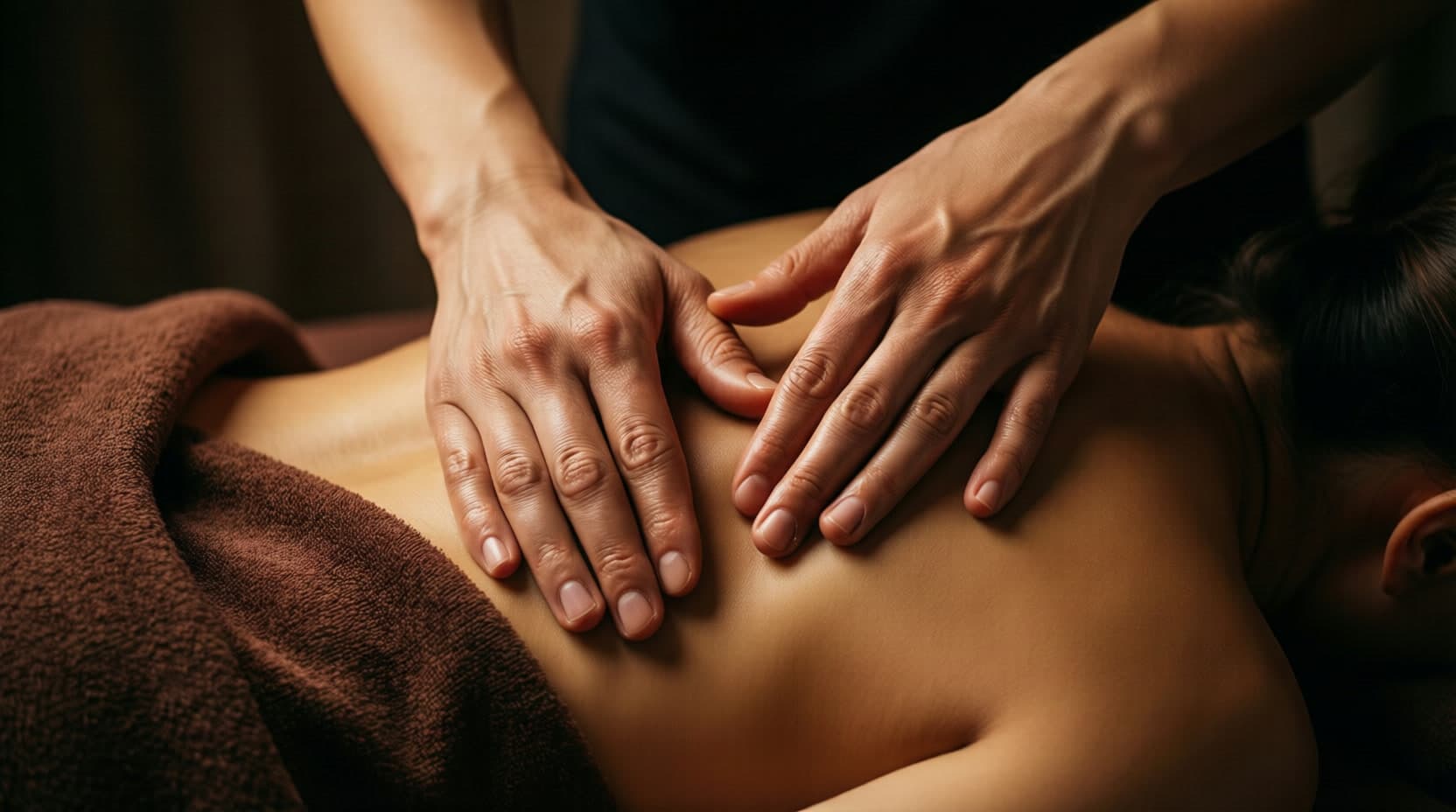
Light pressure works at the surface: skin, fascia, the outer layer of muscle. On a booking form this maps to a classic Swedish massage. It's sometimes dismissed as "just relaxation," which underrates it — light, rhythmic work is precisely what shifts the body into its rest-and-recover state, and it's the level we reach for when the goal is stress, sleep, or a nervous system that's been running hot. If your shoulders live somewhere near your ears by Friday, light work is not the consolation prize. It may be the assignment.
Medium
Medium pressure engages the muscle belly itself — enough force that you clearly feel the muscle being worked, never enough that you'd call it intense. Most sessions in our practice live here for most of their duration. It's the default for people who want real work done and also want to leave the table relaxed rather than wrung out.
Deep
Deep pressure means slow, sustained force into the deeper muscle layers — the territory of deep tissue massage. Two things distinguish it besides force. Speed: deep work is slow, because tissue yields to sustained pressure and defends against fast pressure. And specificity: it's applied to particular structures that need it, not ground uniformly into the whole body. A good deep tissue session is targeted excavation, not a harder version of everything.
Productive discomfort has a signature
Deep work can be intense, and there's a sensation clients call the "good hurt" — a strong, almost satisfying ache, often with a sense of this is exactly the spot. That's productive discomfort, and it has a reliable signature: you can breathe slowly through it, your body stays heavy on the table, and if pressed to rate it you'd land around a six or seven out of ten, not a nine.
Past that line, the signs flip. You hold your breath. The muscle braces against the pressure. Your hand grips the table. Sensation turns sharp or electric instead of achy. That's no longer productive — a muscle actively defending itself is doing the opposite of releasing, and work at that intensity mostly buys extra soreness tomorrow. When we see those signs, we ease off without being asked. But we'd always rather hear it from you first.
Worth knowing: your tolerance isn't fixed. The same spot that reads as an eight in the first ten minutes often accepts far more pressure twenty minutes in, once the surrounding tissue has warmed and the nervous system has settled. This is another reason good deep work starts moderate and builds — and why the deepest work in a session usually happens in the second half.
The words to use mid-session
Clients sometimes rehearse elaborate phrasings so as not to offend. Skip all that. These work, verbatim, at any moment:
- "A little lighter there."
- "You can go deeper on that spot."
- "That's sharp — different angle?"
- "Perfect, stay right there."
- "Can we skip that area today?"
That's the entire skill. No preamble, no apology. A therapist worth hiring treats these as navigation data, and every one of them makes your session better, not awkward.
Three pressure myths, retired
"No pain, no gain." Borrowed from the gym and wrong even there. Tension release comes from pressure the body accepts, not pressure it survives. The wince is not the work.
"Deep tissue is the serious massage; everything else is fluff." Depth is a tool matched to a goal. Chronic knots in a shoulder respond to deep, specific work; an anxious, sleep-deprived nervous system responds to lighter, rhythmic work. Booking deep tissue for a stress problem is like using a chisel to paint — we've unpacked this one alongside others in our post on common massage myths.
"Asking for less pressure wastes the session." Lighter pressure applied to a relaxed body reaches further than heavy pressure applied to a braced one. Nothing is wasted except tension.
What to actually book
If you're new and unsure, book the session length you want and tell us your goal — sleep better, loosen a shoulder, recover from training — rather than pre-committing to a pressure. We start moderate, calibrate with you in the first few minutes, and adjust from there; different areas of the same body often want different depths anyway. Session options and rates are on the pricing page, and every massage comes with an unlimited supply of mid-session adjustments, free of charge.
Ready to book?
Book your mobile massage onlineQuestions
Frequently asked
Keep reading
Related articles
Ready to book?
We bring the table, linens, and calm — you keep the couch afterward.