
Pain Relief
What Is a Muscle Knot? An Honest Answer
Nothing in your shoulder is literally knotted. What that tender, ropy spot actually is remains one of the most honest open questions in bodywork — and the uncertainty matters less than you would think.
Published 4/19/2026· By Kristian Fennessy, CMT
Nothing is actually knotted
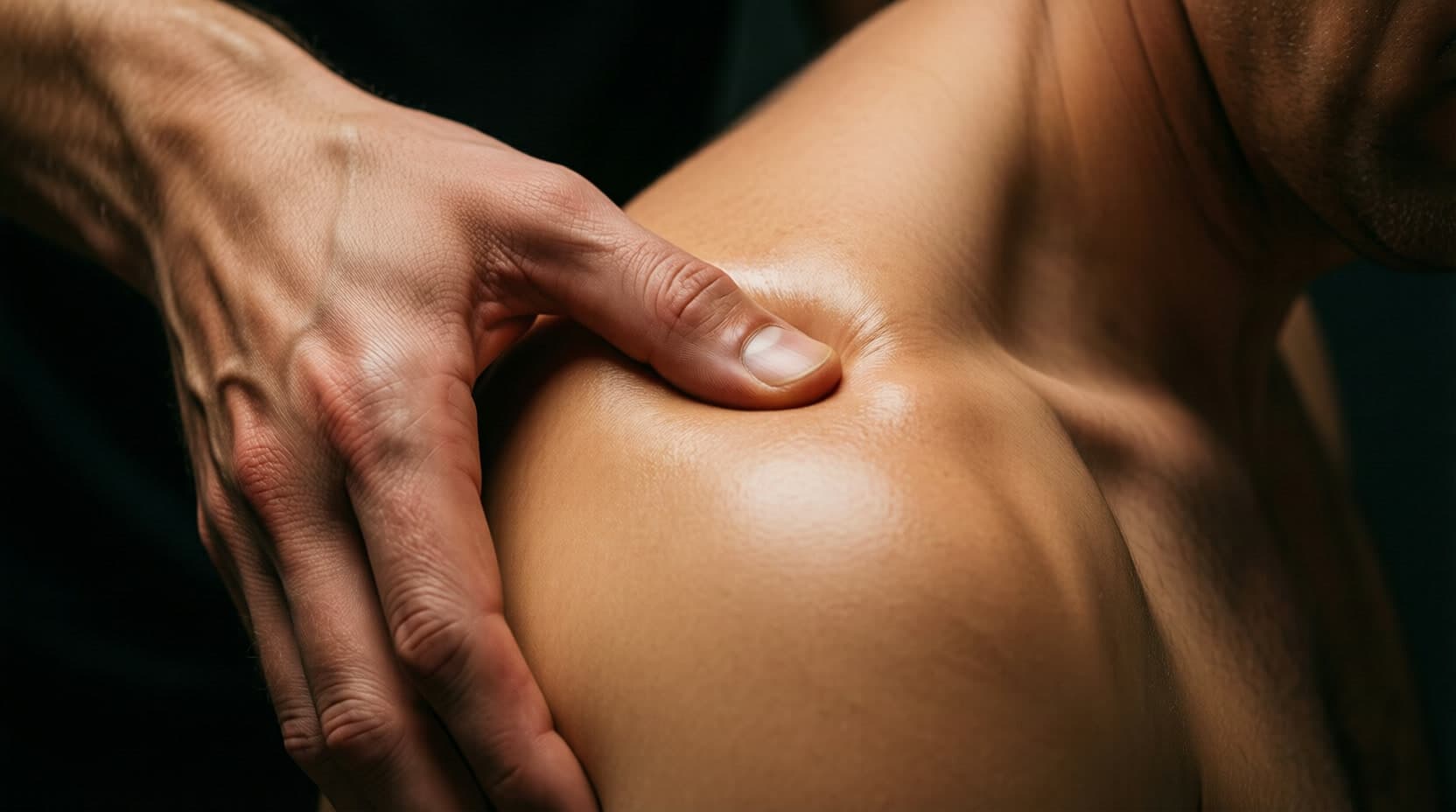
Let's answer the question directly: a muscle knot is a spot in a muscle that feels firm and tender and often ropy under the fingers — and nobody, including the researchers who study this for a living, knows precisely what it is. No fiber is tangled. Nothing is tied. If you imaged that spot in your upper trapezius, you would not see a lump.
We realize that is a strange admission from people who spend their working days finding these spots and pressing on them. But we would rather tell you the honest version than a tidy story, because the tidy stories about knots tend to fall apart under scrutiny — and because the uncertainty changes less than you might expect about what actually helps.
What we know, and what we don't
Start with what is solid. The sensation is real and reproducible. You can find the spot yourself, a therapist can find the same spot without you pointing to it, and pressing it produces that distinctive deep ache that people describe, almost universally, as somehow satisfying. The spot behaves consistently: it softens under sustained pressure, it aches after long static postures, and it comes back in the same neighborhoods — upper traps, between the shoulder blades, the glutes.
Now the unsettled part. For decades the dominant explanation was trigger point theory: microscopic patches of muscle stuck in contraction, starving themselves of blood flow, forming taut bands that refer pain elsewhere. It is a useful clinical map — we use its referral patterns constantly, and we have written about how trigger point work is done in practice. But when researchers went looking for the physical evidence, it proved slippery. Different examiners often could not agree on where the points were. Imaging could not consistently show them. Biopsies did not settle it either.
The more current thinking leans neuromuscular: the spot may be less a piece of damaged tissue and more a patch of muscle the nervous system is holding in low-grade contraction — a protective habit, maintained by the spinal cord and brain, that becomes sensitized over time. In that model the knot lives partly in the tissue and partly in the signaling around it. That would explain a lot: why stress makes knots worse, why they cluster in postural muscles, why they can ease within minutes under skilled pressure, and why they return when nothing about your week has changed.
We hold all of this loosely. The honest summary is that "knot" names a reliable experience, not a confirmed structure.
Why the uncertainty barely changes the work
Here is what surprises people: on the table, it matters very little which theory wins.
Whatever a knot is, certain things help it let go. Sustained, patient pressure at an intensity you can breathe through. Slow work along the length of the muscle rather than hurried digging. Warmth, both literal and in the pace of the session. And afterward, movement — a muscle that has been convinced to release holds the lesson better if you use it gently the same day.
If the neuromuscular view is right, this makes sense: skilled pressure is not mechanically untying anything, it is giving the nervous system a long, calm counter-argument. Enough safe, specific input at the right intensity, and the system lets the guarding go. That is also why bulldozing a knot with maximum force so often backfires — pain is the opposite of a safety signal. Firm work has its place, and deep tissue sessions are much of what we do, but productive intensity and punishment are different things. If you are unsure where that line sits for you, we wrote a guide to massage pressure that covers it.
Why knots come back
Because you go home. The eight hours at the desk in Sorrento Valley, the paddle-outs at Sunset Cliffs, the clenched jaw in traffic on the 5 — whatever daily input built the pattern is still there on Monday. A session can reset the tissue; it cannot rewrite your week.
This is why we are candid with clients about frequency. If a knot is the product of an unusual week, one session may genuinely clear it. If it is the product of your ordinary life, expect it to re-form, more slowly each time, and treat massage as maintenance on a pattern rather than a one-time repair. Changing the input helps more than any technique we own: raise the monitor, break up the sitting, address the stress. We say that knowing it is advice against our own economic interest.
One boundary worth stating plainly: a lump that is growing, that sits outside the muscle, that comes with numbness or weakness, or that wakes you at night regardless of position is not a knot conversation. That goes to a physician first, and we will tell you so if we find one.
Ready to book?
If there is a spot in your shoulders that has been asking for attention, we bring the table to you anywhere in San Diego County.
Book a mobile session onlineQuestions
Frequently asked
Keep reading
Related articles
Ready to book?
We bring the table, linens, and calm — you keep the couch afterward.